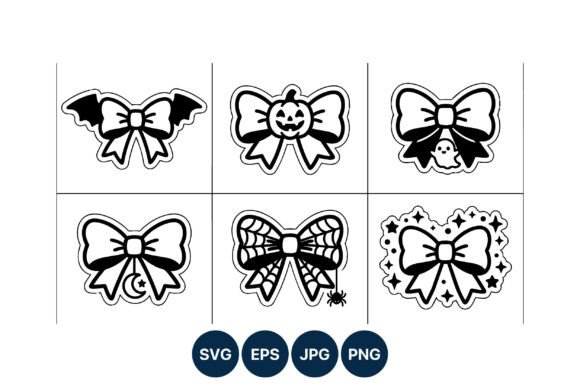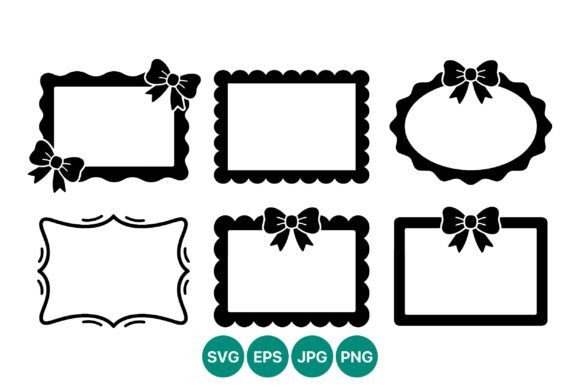
Black White Frames with Bows
A Clean, Timeless Accent—Not a Standalone Statement
First impression? Black White Frames with Bows lands like a quiet exhale—refined, intentional, and effortlessly elegant. It’s not loud or trendy; it’s the kind of illustration that whispers “thoughtful detail” rather than shouts “look at me.” The six frames vary in shape—oval, rectangle, circle, rounded square—but share consistent visual DNA: crisp scalloped edges, delicate bow motifs rendered in fine vector line art, and strict black-and-white contrast. There’s no shading, no gradients, no texture—just confident negative space and clean contours. That makes it feel less like a busy graphic and more like a design *framework*: a ready-made border for monograms, names, dates, tiny icons, or even minimalist embroidery quotes.
Where It Shines in Real Embroidery Projects
I recently tested Black White Frames with Bows on a linen-cotton blend tea towel destined for a local boutique’s holiday collection. I paired one oval frame with a simple “Joy” script inside—no fill stitch, just satin-stitched outlines and a few running-stitch bows. The result was instantly cohesive, upscale, and handmade without looking fussy. That’s the sweet spot: Black White Frames with Bows works best when it supports something else. Think embroidered baby onesies with a tiny name inside a round frame, custom tote bags featuring a small monogrammed rectangle, or pillow covers where a scalloped square holds a seasonal icon (a sprig of holly, a crescent moon, a single star). It also translates beautifully to embroidered patches—especially for craft fairs or Etsy listings—where clean lines and strong contrast read well from a distance and hold up through repeated washing.
For sweatshirt embroidery or custom apparel, choose the larger frame shapes and keep stitch density moderate. The line art style avoids heavy fill areas, so it stitches quickly and lies flat—even on midweight fleece or French terry. On baby embroidery or nursery decor, the gentle curves and bows add softness without cutesy clutter. And because it’s purely black and white, it pairs equally well with natural fabric tones (cream, oat, charcoal) and bold solids (navy, burgundy, forest green), giving your craft business flexibility across product lines.
Where to Pause—and Test First
Don’t assume Black White Frames with Bows will behave the same on every surface. On stretchy knits like t-shirts or curved cap fronts, those fine scallops and bow loops can distort if stabilizer isn’t matched precisely to fabric weight. I recommend medium-weight cutaway stabilizer for anything with give—and always test on scrap first. Tiny corners and tight bow knots are vulnerable on thin fabrics (like lightweight muslin or voile); they may fray or lose definition after laundering unless you reinforce with a light tear-away or use a denser satin stitch setting.
Dark fabric backgrounds demand extra attention: check how the white elements render in your embroidery file. Since the download includes SVG, PNG, JPG, and EPS files, confirm which version you’re converting for your machine—some PNGs embed anti-aliasing that muddies fine lines. Also, avoid placing any frame too close to seams, hems, or curved edges (like apron pockets or tote bag gussets), where tension shifts can pull scallops out of alignment. And while the design is versatile, it’s not ideal for ultra-small hoops (under 3.5 inches): the smallest frame in the set still needs breathing room to read as intentional—not cramped.
What It Adds to Your Finished Product—Beyond Aesthetics
Using Black White Frames with Bows quietly elevates perceived value. Customers recognize craftsmanship in clean edges and balanced spacing—it signals care, not automation. For Etsy sellers and small shop owners, that translates to stronger buyer engagement: people linger longer on listings with polished, cohesive visuals, and they’re more likely to trust a brand that presents details thoughtfully. It also reinforces brand consistency across product types—same frame shape on a kitchen towel, a baby blanket, and a holiday card mockup builds recognition without repetition feeling stale.
As a personalized gift element, it adds structure without overwhelming sentiment. A monogrammed rectangle frame on a linen napkin feels special but not saccharine. And because it’s vector-based line art, it scales cleanly for printable mockups—essential for digital product sellers who need crisp previews for social media or product pages.
Practical Designer Notes Before You Stitch
- Always test the chosen frame on scrap fabric matching your final project’s weight, weave, and stretch.
- Check thread color contrast—especially if stitching white-on-white or black-on-charcoal; subtle differences matter in person.
- Review stitch density in your embroidery software; reduce fill if using on textured fabrics like toweling or bouclé.
- Confirm hoop size compatibility before digitizing—some frames may require repositioning for smaller hoops.
- Inspect small details in your preview: bow loops, scallop peaks, and inner frame edges should be smooth and evenly spaced.
- Test in black-and-white mockups to verify readability on both light and dark fabric backgrounds.
- Use proper stabilizer—cutaway for knits, tear-away for stable wovens, and fusible for lightweight layers.
- Verify licensing terms before selling finished items or bundling Black White Frames with Bows into digital embroidery kits.
In short: Black White Frames with Bows isn’t flashy—but it’s reliable, adaptable, and quietly sophisticated. It belongs in the toolkit of embroidery designers, craft business owners, and makers who understand that sometimes the most powerful design choice is restraint. Use it to frame meaning, not fill space. And let the simplicity do the work.